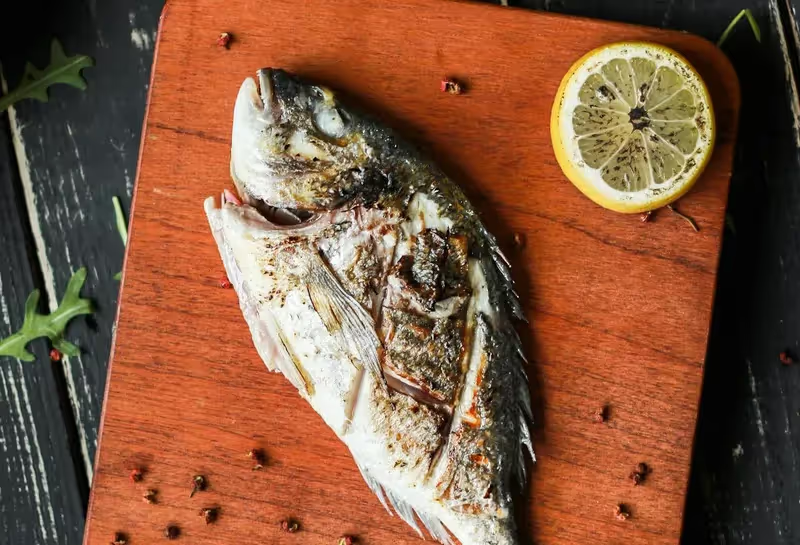
Few things on a passage compare to the moment a line goes tight. The shout from the cockpit, the scramble for gloves, the flashing silver and blue as a bonito or dorado comes alongside. An hour later, the whole crew is gathered around fillets sizzling on a hot pan with garlic and lemon, eating better than any restaurant ashore could manage. That single fish can turn an ordinary watch rotation into the best day of the trip. But here is the thing: that fish was never in the meal plan. And it should not have been. Fishing under way is one of the great pleasures of offshore sailing, but it is not provisioning. The stores are the plan. The fish are the reward — and everything about the experience is better when they arrive as a surprise rather than a necessity.
Why This Matters for Meal Planning
When provisioning for a long passage or ocean crossing, every meal slot needs to be covered by food already on board. Fresh stores for the first days, shelf-stable supplies for the rest. If a fish comes aboard, it replaces a planned meal — freeing up a can of tuna or a portion of pasta for later. This is how fishing extends provisions rather than creating a gap in them. The morale effect is real. Offshore days can blur together. When someone hooks a fish, the whole crew wakes up. Plan the stores as if nothing will be caught, and every fish becomes a genuine event.
What You Can Expect to Catch
Species vary by region, but what matters is not variety — it is likelihood.
Mediterranean (Greece, Croatia, Turkey, Italy, Spain)
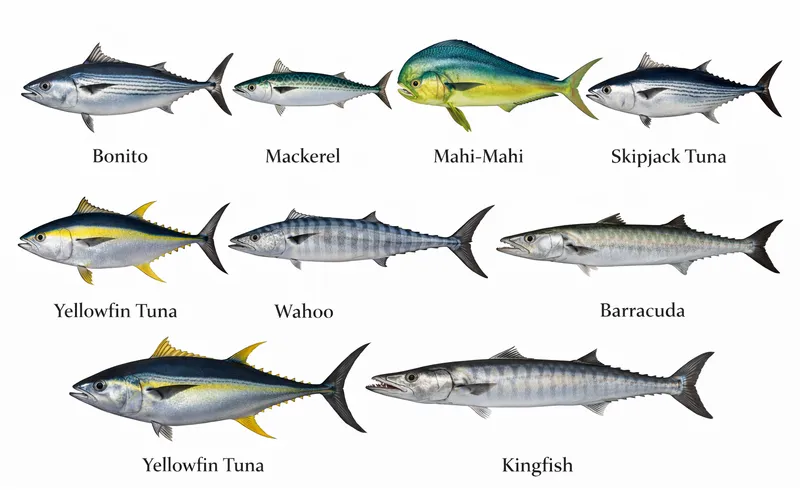
The Mediterranean is not a high-yield trolling ground, so expectations should stay realistic. The most common catch is bonito (palamida), a smaller relative of tuna, typically in the 1–3 kg range. They are fast, strike aggressively, and are excellent eating when fresh. Mackerel are another reliable option, especially nearshore and between islands, and are often the most consistent catch for casual crews. Dorado (lampuga) appear seasonally from late summer into autumn, usually around floating debris where they hunt. This is a pelagic species, brightly coloured and fast-moving, and one of the more rewarding catches while sailing. It should not be confused with dorada (sea bream), which is a completely different coastal fish caught near the bottom and rarely while trolling under way. Occasionally, a small tuna or amberjack will take a trolling lure, though these are less common on typical charter routes. In practical terms, if you catch a few fish over a week of sailing in the Mediterranean, you are doing well. Fishing here adds interest and occasional fresh meals, but it is not something to rely on.
Atlantic Crossing (Canaries to Caribbean)
This is where fishing under way becomes consistent and genuinely productive. The primary species is mahi-mahi (also called dorado or lampuga), a fast-growing, aggressive fish that is easy to recognise by its bright green and yellow colouring. They tend to gather around floating debris and weed lines, and are one of the most reliable offshore catches. Typical fish range from 7 to 15 kg, providing a substantial amount of food for a small crew. Skipjack tuna and small yellowfin tuna are also common and dependable. They are strong fighters but manageable on simple gear, and excellent eating. Wahoo appear less frequently but are highly prized — long, fast fish with firm white flesh. At night, flying fish often land on deck. While small, they are edible and, more importantly, indicate that larger predators are active nearby. In this environment, fishing can meaningfully extend provisions, sometimes providing multiple meals from a single catch. Even so, it should still be treated as a bonus rather than part of the core plan.
Caribbean and Tropical Waters
Offshore, the same species dominate: mahi-mahi (dorado), tuna, and wahoo. Closer to islands, particularly around reefs and shallower waters, barracuda and kingfish become more common. This is also where caution becomes important. Ciguatera poisoning is a real risk in tropical reef environments and is associated with larger reef-dwelling predators. Barracuda in particular should be treated with caution, especially larger specimens. When in doubt, local knowledge is essential — fishermen and marina operators will usually know which species are safe to eat in a given area. Fishing in tropical waters can be productive, but it requires a basic understanding of what you are catching, not just how to catch it.
Equipment: Keep It Simple
A sailing yacht does not need sport fishing gear. The goal is a setup that can be deployed quickly and ignored until something happens. One line trailing 20–40 metres behind the boat at 5–7 knots, set and forget. If it requires constant attention, it is too complex.
Handline (minimalist)
The simplest and most space-efficient option. A commercial-grade trolling handline consists of roughly 30 metres of heavy monofilament (200–300 lb test), a snap swivel, a short leader, and a lure. The heavy line is not about catching giant fish — it is about being able to grip the line safely with gloved hands when hauling in a catch. A rubber snubber (shock absorber) between the line and a strong cleat is essential; without it, a sudden strike can snap the line or pull gear overboard. Handlines stow in a bag the size of a water bottle. No moving parts, no corrosion, no maintenance. For most crews, this is all that is needed.
Rod and reel
A single rod rated for 30–50 lb line gives control when playing a fish and is easier on the hands. The downsides are real: it requires storage, rod holders need to be fitted, and salt water destroys cheap reels quickly. Rinsing the reel with fresh water after every use is necessary — on a passage where fresh water is rationed, that becomes a genuine consideration.
Lures
Keep the selection small. One bright skirted lure, one dark, a cedar plug, and a couple of feathered jigs will cover most situations. Bright colours work in clear, sunny conditions; darker profiles show up better on overcast days or at dawn and dusk. Stick to 10–15 cm lures — this targets the species most likely to be encountered at sailing speed. Bigger lures attract bigger fish that a handline setup cannot handle safely.
Other essentials
Heavy-duty gloves for handling line and fish. A sharp filleting knife kept separate from the galley knives. A dedicated cutting board that stays in the cockpit. A gaff or large landing net if available. Crimps, spare swivels, and a few extra hooks — lures will be lost to larger fish or debris.
Handling the Catch
Speed matters, especially in warm climates.
A small fish under 2–3 kg can go straight to preparation. If it is larger — a good-sized dorado or tuna — portion it immediately. Eat what the crew can finish in one sitting and deal with the rest right away. For preserving surplus, salt-curing buys an extra day or two: pack portions in coarse salt in a sealed bag, refrigerate if possible, and rinse before eating. Ceviche is an excellent offshore option — no cooking, no fuel, no heat in the galley. Dice the fish, cover with lime or lemon juice, add onion and chilli, wait 20 minutes. On boats with limited or no refrigeration, anything not eaten or preserved within a few hours should be discarded, especially in the tropics. Fish prep belongs in the cockpit, not the galley. Blood and scales in a small galley create mess and smell that linger for days. Rinse the cockpit with salt water afterwards.
Regulations: Are You Allowed to Fish?
In many cruising areas, recreational fishing from a yacht is allowed — but not always unrestricted. In the Mediterranean, rules vary by country and are more regulated than many sailors expect. In Greece, a recreational fishing licence is officially required even for simple trolling, though enforcement varies. Croatia is stricter: permits are required, and there are limits on gear and catch. Italy and Spain also apply regional licensing rules. In practice, one simple trolling line for personal use is often tolerated, but it is still technically regulated. In the Caribbean, offshore trolling is generally more relaxed, especially while under way between islands. However, within territorial waters — Bahamas, Barbados, or British Virgin Islands, for example — permits may be required, and protected species rules are strictly enforced. As a rule: one or two trolling lines for personal consumption is often acceptable offshore, but spearfishing, traps, or multiple lines can quickly fall under regulation. Always check local rules before departure.
Common Mistakes
- Counting fish as provisioned meals. This is the big one. If the fish do not come and the stores do not cover the gap, the crew eats poorly for the remainder of the passage.
- Running multiple lines. One line is simple. Two lines tangle, require monitoring, and create problems in a gybe or sail change. Keep it to one unless the crew has fishing experience.
- No shock absorber on the line. A direct connection from lure to cleat will either snap or damage fittings when a fast-swimming fish strikes at speed.
- Fishing in traffic or near reefs. Shipping lanes mean hauling in quickly; near reefs, the risk of snagging and losing gear is high, and reef fish carry ciguatera risk in tropical waters.
- Not having tools ready. Catching a fish and then discovering the knife is buried in a locker, there are no lemons on board, and the cutting board is under the dinghy — this happens more often than it should.
- Ignoring regulations. Some countries require a licence even for a single trolling line. Getting it wrong can mean a fine or confiscated gear.
Pro Tips
- Deploy the line at dawn and retrieve it at dusk. Most pelagic predators feed hardest in the first and last hours of daylight. Trailing a line overnight risks catching something too large to handle safely in the dark.
- Watch for birds. Circling seabirds — especially frigatebirds and shearwaters — often indicate baitfish being driven to the surface by predators underneath. Adjusting course slightly toward bird activity, without losing significant ground, is worth the detour.
- Keep a few lemons and a small bottle of soy sauce accessible from the cockpit, not buried in the galley. These two items transform raw fish into a proper meal in minutes.
- Mahi-mahi often travel in pairs or small groups. If one is hooked, leaving it in the water briefly can keep others nearby, giving a chance at a second catch.
- Simple setups catch more fish — because they stay in the water. A complicated rig that gets stowed after one frustrating tangle catches nothing.
Conclusion
Fishing under way is one of the real pleasures of offshore sailing — but it is not something to depend on. Provision as if nothing will be caught. Set up simply so you can take advantage of what comes. The stores are the plan. The fish are the reward.